Showing posts with label Lenses. Show all posts

Wednesday, March 04, 2015

My Brand New Apps Are Ready To Go At Only $1.99 each!

Good Morning Everybody,

I know I’ve been laying low for a while but  I’m writing today to get the news out about my brand new $1.99 Photography Apps!

Here is the backstory. Last year, my good friend and great photographer Rick Sammon,  asked me to be part of his Mobile Masters Group and twisted my arm to produce three wedding apps [link]. Rick is really an App Master.  I finally completed the project and they look great! Read the rest of the story on the very first set of David Ziser Apps [link] below. You're going to love them

My Brand New Apps Are Ready To Go At Only $1.99 each!

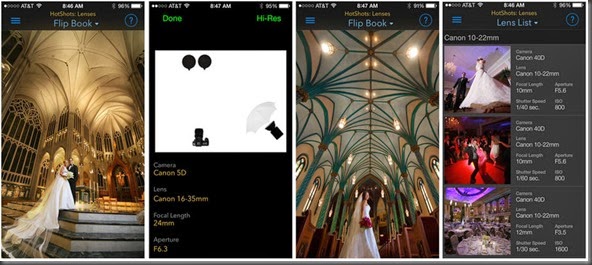
As I mentioned above, I am thrilled to be announcing my brand new Wedding Apps on Lighting, Lenses, and Composition [link].  Each App contains 25 of my favorite images per App topic along with the back story, exposure data, and lighting diagram for each image. I think you'll love them!

For years we've been offering  the Hot Shots Series available at my DigitalProTalk Market Place in a printed version. Now we can offer them at a fraction of the cost - only $1.99 each - in their new App form! The printed version was very popular years ago but technology marches on and now they are a "steal of a deal" for less than two bucks each! 

We offer three titles so far:

David Ziser's Hot Shots Lighting - Lighting creates the mood and feeling in a photograph. Learn from the master, via end-result images and lighting diagrams, how you can create images with impact though the use of lighting.

HotShots App Lighting

David Ziser's Hot Shots Lenses - Lenses help photographers tell a story - their story and the story of the subject. Learn how to use lenses - from wide to telephoto - wisely to capture the all-important, once-in-a-lifetimes event for the bride and groom.

HotShots App Lenses

David Ziser's Hot Shots - Composition - Learn how to successfully compose an image via end-result images and illustrations that explain composition techniques. Camera, lens and exposure info is included too.

HotShots App Comp

I hope you love the Apps. One more time – here is the link to the apps.

Enjoy!  David

p.s. Don't forget - LaDawn wanted me to let you know that she has marked things down again at our Digital Resource Center [link]. Get the deals - some up to 80% off - while they last as we will be closing the Digital Resource Center in this summer.

Tuesday, June 05, 2012

Technique Tuesday: The Only Wide Angle Lens You’ll Ever Need!

Good Afternoon Everybody,

Just to bring you up to date, let me tell you what’s happening around here - it’s all good stuff.  Yesterday, I typed the first 2,200 words of my new book, “Make Your Lighting Exciting”.  I just started typing and the words started flowing – a very good thing for an author ;~) 

Anyway, the book in now on the “front burner” an I’m giving it TOP PRIORITY over everything else here at the studio, including daily posts to DPT.  If I’m going to finish this thing by the end of August, that’s how its’ going to have to be the next few months.  The first words I type each day will be for my book – no exceptions! 

2000FireworksiStock_000004279531XSmaDon’t worry, I’m not giving up on the blog for that time period but look for the blog posts to come later in the day.  I figure 2,000 words a day and I can have the book hammered out in no time.  Total words for my Captured By The Light book last year totaled about 65,000 words so you can see I’m on a “tear’ this time around.  Hey, they always say to write your second book first because you know what you’re doing ;~)

That’s the quick update from me today.  How about we get on with a super-cool Technique today.

The Only Wide Angle Lens You’ll Ever Need!

Canon FisheyeOK, not really but with what I’ve got to show you today you’ll be surprised to see what I pull off with my new Canon 8-15mm Fisheye lens.  The cool thing is that it has little to do with Fisheye photography.  Today it’s all about super- duper extreme wide angle lens photography.  How wide – how about 150 degrees rectilinearly corrected wide angle wonderfulness!  That makes the new Canon lens the new wide angle winner in that department.

OK, so you’re asking, “How in the world can I use a fisheye lens as a regular wide angle lens?”  It’s easy folks, Lightroom 4 and it’s built in lens correction feature. That’s the point of this week’s lesson. Today’s post answer’s the question of what the REAL “Field of View” is for a rectilinearly corrected fisheye image.  OK, I’ll let the “cat out of the box early here. 

Using the Canon 8-15mm fisheye on my Canon 5D Mark III full frame body, I will show you can achieve a true rectilinearly corrected image with a “Field of View” that ranges from 150 degrees down to a still super-wide 133 degrees depending on the zoom setting of the lens.  The studio image below is shot with the Canon fisheye at 14mm corrected in Lightroom showing a 140 degrees “Field of View”! Nothing else comes close to this wide angle feat!

Fisheye Wide angle

Hopefully I’ve got your attention with this intro.  I’ve spent a lot of today developing and organizing the data and the images for this post.  Why not hit the PLAY button below and enjoy one of my favorite Technique Tuesdays ever.  OK, on slight word of caution – I did get little carried away on today’s tutorial and it does run a little long – about 34 minutes long.  But it’s still worth every minute of you time.  I think (and hope) you get a kick out of the video today.  Enjoy!!

_________________________________________________________________

Hey gang, that’s it for me today.  I’ve still got to get my 2,000 words under my belt for today – yes, I gave DPT first billing today because I got so wrapped up into putting things together this morning so now I’ve got to get moving.  I’ll plan to see everybody here again real soon.

Adios for now,  David

Tuesday, April 24, 2012

Technique Tuesday: Understanding The Right Gear To Use For Weddings & Tamron 28-300 VC Lens Review

Good Afternoon Everybody,

CS6It’s a two-for-one post today but before I begin I hope everybody's off to a great start for the week. We just had Adobe CS6 announced and it is looking like one hot upgrade – I can't wait. Want to check out 10 of CS6’s coolest features – you can find the 10 videos right here at photographer, Colby Brown’s site. 

Things are getting busy for us, as usual, as we get ready for our trip to Dallas, Texas.  After just coming off of my Digital Master Class we’ve got to re-organize all the gear for our week long class at Texas School. So prepping for that trip,  getting ready for our free Extreme Digital Design Webcast on Thursday (REGISTER HERE), and our regular studio production items are certainly keeping us busy once again.

I spent most of yesterday organizing the content and images for today's post. I know today is supposed to be our normal Technique Tuesday complete with video  but, I'm changing it up because I have some more important news that I want to discuss with you. ImagesToday's post is a combination of gear discussion and equipment discussion for today's wedding photographers.

I think it's always interesting to read the latest, greatest equipment reviews online and to check out the latest new lenses for our cameras. Little is said in the overall scheme of things about what gear combinations might be the best  for certain shooting situations. That's my topic for today.

Understanding The Best Gear To Use For Weddings

I've been a wedding photographer for a long time and a digital wedding shooter for over 12 years. Over those years I've worked with many different combinations of cameras and lenses. Now, here we are 2012 and I’m finding myself once again reconsidering the best camera/lens combinations for shooting a wedding. Let me be clear – every photographer has their own style and technique when photographing a wedding, myself included. Some photographers prefer the fast glass and medium to long telephotos for capturing the essence of the wedding day. Others newer to the field, unfortunately, may prefer the Canon rebel with the kit lens.

I myself have gone through many equipment combinations and transitions since switching to digital so many years ago. Heck, back in the film days, you bought one camera and used it for 20+ years – not so today.

Canon 7D with 18-200mmFor the last two years my favorite camera/lens combination has been the Canon 7D fitted with the Canon 18-200mm IS lens.  Now before anyone has a conniption fit because I'm not using fast, L-series glass – please hear me out. When I’m shooting the majority of the candid, spontaneous images I’ve always found this camera/lens combo to be a very efficient combination. I found it to be particularly efficient when photographing a wedding reception. If I spotted grandma dancing with one of the groomsmen across the dance floor I can easily zoom out and capture that special moment. No need to run back to my gear bag to grab a longer telephoto lens. The entire shooting process was quick and efficient.

I think a common misconception many photographers have about gear is that they need a whole slew of lenses to get the job done.  Again, don't get me wrong. I do own a whole slew of lenses and use just about all of them on a typical wedding event.  But typically, over these last two years, it's been my Canon 7D/18-200mm IS lens combo that has been my work-horse, been the combo I’ve used most often and has provided for me some really outstanding results.

Lens Meta DataTo give you an example I checked a recent wedding exposing nearly  3800 images over the two day event. Look at the metadata from that event.  Clearly two thirds of those images were taken with the 7D fitted with the 18-200mm IS lens. 800 more of those images were photographed with the Canon 24-105mm IS lens.  I’ve always felt this is one of the sharpest lenses in my gear bag and always reserve it for portraits of the bride and the groom, family groups, and the larger wedding party groups. For many of my wide-angle images I liked using the Sigma 8-16mm lens, and as you can see from the above chart, for about 200 of the images.  So, as you can see, the big favorite was the extremely versatile 18-200mm IS zoom lens.

Again, I know several of you are probably rolling your eyes at my remarks in today's post. But, let me say, for me it's about getting the image, capturing the moment, not taking a chance missing something important as I juggle with my lenses - that's not my style. For me it's ALWAYS about getting the shot!

Another thing I think a lot of photographers fail to realize is that the largest print that's going into a wedding album, particularly with candid images, is typically no larger than a 5x7 or maybe a 8x10 image – and, on the rare occasion, an 10x10. The 18-200mm lens is just fine for many of those images.  Don’t get me wrong – I’ve still made prints up to 24x36 inches from that lens –and they look GREAT!

Wedding Page2

Several times during LaDawn’s design process she will include images that are 10x15 and occasionally even larger in the album. But in most cases those images would've been taken with the much sharper 24-105mm IS L-series lens that I like using for just such photographs.

Wedding Page

The sharper glass is going to be reserved for the top, #1 priority images. The more versatile and faster piece of glass, the 18-200mm IS lens I'll use for the second and third tier images. As I mentioned before, this allows for extreme versatility and fast speed for me with my style of photographing a wedding.

Now please continue reading the following post [link] for the complete low-down on Tamron’s new 28-300mm VC lens.

Tuesday, March 27, 2012

Technique Tuesday: Fish, Fish–Go Away!

Good Morning Everybody,

Photoshop World Washington, DC is wrapped up and we have the next two days off in the city. I’ve got a brand-new Technique Tuesday for you today so why don’t we get right to it.

Fish, Fish–Go Away!

The idea for this Technique Tuesday came when Michael Wiacek and I were sitting around the Speakers lounge at Photoshop World.  I just picked up my brand-new Canon 8–15mm zoomable fisheye lens and was shooting a few photographs with it.

Fisheye lens beforeI was curious to see if I can remove the fisheye effect with this lens correction feature in LR4. I know what you’re thinking – why in the world did I get then lens if I wanted to remove the fisheye effect?  Hey, I just wanted to see if I could do it, that’s all ;~)

As soon as I tried I was left with this BIG gray hole at the bottom of the image. I could have removed it the “constrained crop” box checked but Mike and I (mostly Mike) had an idea on how we could remove it in Photoshop.

All I can say is that one thing led to the other and before long together we had it pretty well figured out.

Another thing that happens when you use the lens correction feature in LR4, it tends to turn your subjects into munchkins if they are positioned pretty far back within the scene. So, we had that problem to solve, too. Hey,  why not hit the PLAY button below and see how we solved the problems and came up with a very, very cool image.

Fish, Fish–Go Away! from David Ziser on Vimeo.

__________________________________________________________________________________

Hey gang, that's it for me today. I promised LaDawn I wouldn’t spend all day on my Technique Tuesday today and it’s already noon. Why? Because we’ve got places to go and things to see.

So, for now, we are out of here.  See everybody tomorrow, David

Wednesday, March 31, 2010

PhotoFavs Wednesday: The Case Against Fast Glass; Follow My Twitterview Tomorrow

Good Morning Everybody,

We landed safe and sound yesterday, unpacked the bags, checked in with the team, and called it a day about 6:00 p.m.  Today it’s back to a normal routine around here which is a good thing.

CAnon Printer We are prepping the space in our production area for next week’s install of the new Canon iPF 8100 printer.  It’s about 2 inches wider than the Epson 9880 it’s replacing.  The problem is that the space is about 1 inch too small to make everything fit.  Don’t you love when that happens.  We’ve got a few work-a-rounds in mind so I’m sure everything will work out just fine.

Follow My Peachpit Twitterview Tomorrow At 2:00p.m. EDT

Peachpit Tomorrow I will answer your most pressing questions (photographywise), in easy-to-manage 140-character bites via Twitter! This grand event will take place tomorrow on Thursday, April 1, at 11 am PST.

To tune in, just follow @Peachpit and @DigitalProTalk. You can even set up a Tweetdeck group with just those 2 tweeps and follow along or search for this hashtag: #CBTL.

Twitterview So here's your chance! What wedding tips have you been dying to know? What should you do on your next wedding shoot?  Check out all the info about my Twitterview right here.  Don’t forget to watch the short 2 minute video too.  We shot it at PSW last week.  Hope to “see” you there - It should be fun.

OK, time to get on with today’s post and I think I’ve got a good one for you, especially if you are considering purchasing any new lenses soon.  So, let’s get right to it.  Here we go…

The Case Against Fast Glass

No Fast GlassDid the title get your attention;~) I thought this post title might really fire up the large F-stop prime lens shooters but here goes anyway. 

You know, all the time, I'm asked why I don't shoot lens with those big fat F-stops. Look at any of my "Image of the Day" posts and you will see I'm usually (like never) at the maximum aperture of the lens I'm shooting. In most cases I’m never using “L-Series” lenses – Canon’s really high priced spread.

OK, why do I shy away from that "big boy" glass?  Here's why…… I just don't need them. 

Hit the “Read More…” link below for the rest of my story.

Now the rest of the story is this.  I really don't need them for my style of shooting.  How often am I shooting with just the available light.

In reality, it is very seldom. Sure, Jeff Ascough [link] gets away with it every weekend – but, it’s his STYLE of shooting.  That’s why he is such a big fan of fast glass.  By the way, Jeff, congrats on you being named as an upcoming Lens & Light Honoree at BestOfWeddingPhotography.com.

Those that know me, know that my “gig” is lighting – lot’s of creative on-camera and off-camera flash.  This is true for most of my wedding/portrait photography.  Is that a bad thing?  Of course not – it’s just my style.

An Elegant Afternoon I love the challenge of placing that light, or more accurately stated, the “tonal values” of the scene right where I want them.  That’s how I create those dramatic images.  For me it’s about MAKING the lighting exciting!

That is not to say that some lighting is NOT exciting all by itself - any self respecting sunset knows that’s some exciting lighting.

Let’s look how often I shoot without flash.  I begin the wedding coverage with two cameras – one with a flash mounted on it, and the other with that rare gem, a 50mm F1.4 lens attached.  The second lens is the one I use for those truly candid shots.  But even with that lens on the camera, I still shoot it at mostly F2.0.  Why, it’s about the depth of field.  F1.4 is just too shallow a depth of field for me.  Frankly, too many of my images are too far out of focus for my tastes when using the lens wide open.

50mm F1.4 That easily explains why I would NEVER pick up a 85mm F1.2 lens for the whopping price of $1,800!  Heck, Zack Arias suggested a 85mm F 1.8 lens as a great starter lens for new photographers.  Hey, I can’t disagree with that.  I would never hang out at that F1.2 range anyway.  My gosh, the depth of field of the 85mm at F1.2 on a Canon 7D is less than 2.5 inches at 10 feet!!!

OK, I know a few folks are going to disagree with me.  They are going to contend that the fast glass opens up a brand new set of shooting possibilities for the wedding/portrait photographer.  I don’t disagree with this either. Remember, I do take a few images with my wider aperture 50mm F1.4 lens.  But stylistically, it’s just not my thing.

Of course I shoot the entire wedding ceremony without flash.  In fact the only time a flash SHOULD fire during the ceremony is during the procession and recession only – NO FLASH during the ceremony EVER!!!

Little Ringbearer Don’t I want fat F-stops for those shots? Not necessarily.  I like to shoot my 70-200mm F2.8 IS lens at F3.5 because of the slightly extra depth of field. For most of my ceremony shots, I prefer my 70-300mm F3.5-5.6 DO IS lens on my Canon 7D.  With that lens “racked out” to 300mm on the 7D camera body you have an effective 480mm focal length.  Now you can really shoot those “reach out and touch somebody” candids.

Toast Rider I  also do some “available light” shooting at the wedding reception, but not a great deal.  My 50mm F1.4 and 70-200mm IS lenses work just fine for those candid shots.

Am I putting down those that love their fast glass – of course not.  Go for it.  I would rather spend my money on more intermediate priced lenses, for example, the 24-105mm IS lens at only $1100.  This is one of my favorite lenses. It’s fast enough for many “available light” shots but still gives me a good range of zoom focal length that helps me avoid the “lens changing juggle” at a wedding.

For me too, it’s about getting the expressions quickly and efficiently.  That’s what the 24-105mm IS lens allows me to accomplish easily.

High ISOs Let’s talk a bit more about the F4.0 or even F5.6 maximum apertures on some of the lenses I use.  OK, What has become the great equalizer of the slower vs. faster glass in recent years?  It’s clearly the new crop of high ISO cameras from both Canon and Nikon.  Couple that with the new noise cancelling capabilities of Lightroom 3 and lots of the advantages of shooting fast glass is falling by the wayside.

The “fast glass” advantage before revolved around the ability to shoot at faster shutter speeds to stop the action and reduce camera shake.  The other advantage rested in the stylistic rendition of the image with an extremely shallow depth of field.  High ISO cameras remove all the fast glass advantages except shallow depth of field.

Think about it.  Shooting at F2.0 at 1/60 second at ISO 400 was a good thing in low light situations.  But, heck, now I can shoot F4.0 at 1/250 second at a perfectly respectable ISO 6400.  Add a little noise reduction and I’m' home free.

The bottom line for me is this:

1. My style let’s me shoot at higher ISO’s and consequently smaller F-stops.

2.  I’m a “light guy” and light using my strobes creatively.  Fast glass is inconsequential to my results.

3. For shooting quickly, I like the longer range of focal lengths of the slower glass (offset by the higher ISO cameras).

4. My shooting style is not predominately available light only so I really don’t need a heavy (literally) fast glass.

5. I prefer flattering my subjects with “flattering” light that I can bring to the shoot and I do that at my favorite F 5.6 aperture.

6. I prefer the versatility of shooting with “room lights” at the wedding reception.  I typically shoot my reception candids at F6.3. with three lights firing at a wedding reception, one on camera ( fill-light only), one held by my assistant (main light), and the third on a light stand in the corner of the room. I can come up with some great spontaneous shots that would be completely missed by the fast glass shooters.

7.  I mix my flash shots with my available light shots which gives me a wider range of image options for my clients – photographically speaking at least.

8. And, I’m cheap and don’t want to spend the giant sized bucks on a 85mm or 50mm F1.2 lens.

Anyway, it takes more that one style of photography to make the photographic world go ‘round and my photographic style finds no compromise when choosing not to use fast fat glass.

Hey, just my opinion.  But, you know in your hearts, that I’m right :~) 

_________________________________________________________

Hey gang, on that note I’m out of here.  It’s back to my real job today.  Why don’t you drop your own thoughts in the “Comments” section below and become part of the “fast glass – no fast glass” conversation.

I’ll plan to see everyone tomorrow for another profit building episode of Business Day Thursday - “How To Make A Little Add Up To A Lot.”

See ya’ then,  -David

Wednesday, July 02, 2008

It's In The Bag - Why You Need These Lenses On A Wedding

Good Afternoon Everybody,

A quick note on yesterday's post - I found out that the Technique Tuesday tutorial had a slight hiccup and didn't make it on-line till 6:00 p.m. It's up and running now so scroll down and give it a peek. It's a Cecil B. DeMille, George Lucas, Steven Spielberg extravaganza!!!

OK gang, today I'm grabbing one of the most requested Skribit questions, "What's the best recommendations of lenses to use at a wedding?" Well, first, let me say, "It kind of depends on your budget." So dear reader, let me start with the basic set-up and move up to the exotic and pricey options.

Let's talk cameras first. Regardless of whether you are a Canon or Nikon shooter, I would be choosing one of the models with the APS-C sensor size. I'm a Canon shooter and love the Canon 40D. If I were a Nikon shooter, I'd definitely be looking at the new D300. Nikon has finally got pretty darn close to Canon in the low noise area with their new D3 and D300 series of cameras. Why do I love the APS-C size sensors? Because basically I'm cheap. What's the #1 characteristic of photographers? We are all CHEAP...... 'nough said here.

How does that help me? Well, now I can buy a long lens and get 1.5-1.6x the focal length out of the glass. I love having a 300mm optic on my camera when I really only had to buy a 200mm lenses, but I digress. Bottom line - shoot with a Canon 40D or a Nikon D300 - both solid choices for the wedding shooter. By the way, both also offer highlight protection for the JPEG shooter in the form of Highlight Tone Priority on the Canon side and Active D-Lighting on the Nikon side. Both settings also work on RAW as well. Bob Atkins had some Canon flavored discussion on the topic over at his site right here.

OK, on with the lenses. Hit the "Read More..." link below for what's in my gear bag.

If you are in the Canon camp, pick up their 17-85mm IS lens if you don't own it already. On the Nikon side, pick up the 18-200mm VR lens (sweet range.) I wish Canon went that wide. In any case, because of the very wide focal length of these two lenses, you can just about shoot an entire wedding with those lens choices. Wait there is more, you didn't hear it from me, but I know a certain third party manufacturer is coming out with a 15:1 image stabilized zoom in the next few months. Unfortunately, I'm sworn to secrecy under penalty of death so I can't tell you more but, as soon as possible I'll be reporting with this latest, greatest lens. I can only hope Maxwell Smart isn't lurking in the shadows as I write this.

What's the second lens to purchase? It's really a "no-brainer" - pick up either manufacturer's 50mm lenses. Spend about $320 dollars and you can get a 50mm F1.4's from B&H. Want to save a bundle and only lose 1/2 stop, pick up the F1.8 versions - either lens is only about $80. Folks, that's a steal since the optical quality is pretty darn close to the F1.4 variety.

On to number 3. I would pick up a 70-200mm image stabilized lens. Yes, I know it's pricey but worth every cent. On the Canon side, you have a choice of the lens in either an F2.8 or F4.0 version. The F4.0 version saves you about $500.

Hey gang, these are the BIG THREE that need to be in your camera case. You can get into pricier models and different focal lengths, but these are still my favorites. I also have another "Lens Rule" - if it's available image stabilized - BUY IT. Read my lips - do not settle for less. The image stabilized lenses offer many more possibilities in getting a lot more shots in the day than shooting with the alternative non IS/VR lens.

The next lens I would pick up would be one of the super wide lenses. That would be the 10-22mm (107 degrees wide) wide angle on the Canon side or the 12-24mm (99 degrees wide) on the Nikon side. This is about all the "wide angle" you will ever need. You can put together some pretty cool images with these wide angle optics. How wide are they? Heck, when I put the camera up to my eye with one of these babies on it, I can actually see people approaching me from behind. OK, OK, I'm exaggerating a bit here, but they truly are reeealy, reeealy wide.

Oh, and did I say that they don't really break the bank. Well, maybe slightly, but still great lens to have in your bag. How much are they? These lenses run about $700 for the Canon version and $900 for the Nikon version when I last checked. Hey, in the old days, I spent $5000 on my Distagon 40mm f/4.0 Lens (89 degrees wide) for my Hassy. We certainly have it so good in these digital days.

One last lens just for fun would be the Sigma 8mm Fisheye. It's just a fun lens to have in the bag. There are some interesting creative possibilities, and guess what, you would probably be the only one on the block with one. It's the difference that makes the difference, you know.

You know, at this point the list could go on and on. I picked up the 100mm Macro lens for my Canon and it's fun to shoot. I just wish it was image stabilized like the Nikon version. Anther lens I'm looking at right now is the 14mm Fisheye, but I keep hesitating because my 10-22mm wide angle is wider that the 14mm after taking in the 1.6x magnification factor on my 40D. Just do the math - the 10mm lens is really a 16mm optic while the 14mm Fisheye becomes a 2mm optic. One last lens I'm also looking at is a perspective control lens. You can focus from here to infinity with the tilt function of the lens. No, it's not auto-focus, hey I'm over fifty so that's not a good thing, but I still would like to play with it even though it's a bit pricey.

The last lens in my bag I didn't mention is my Canon 70-300mm DO IS lens. It becomes almost a 500mm (actually 480mm) optic on my 40D - which is pretty cool. Did I mention that I have taken pictures down to 1/6 second with that lens. Yep, it is pretty cool to get really great available light ceremony shots with that lens. Also, I have a Canon 24-105mm lens I picked up for my Canon 5D. I really don't use the Canon 5D anymore - it's the "highlight tone priority" thing with the 40D. Now put the 24-105mm on the 40D and you have one of Canon's sharpest "tacks in the box" for your wedding party groups and general shooting. I still occasionally get cramped with the 24mm setting which means I switch back to the 17-85mm.

Here is the quick recap:

The BIG THREE
-Canon: 17-85mm IS (24-105mm IS is a good choice too but it might cramp you now and then), 50mm F1.4, 70-200mm f2.4 or F4.0 IS it's all about the budget here.
-Nikon: 18-200mm VR (great range for the wedding shooter and sharp enough especially at F6.3), 50mm F1.4, 70-200mm F2.8 VR

Now GO WIDE:
Canon: 10-22mm wide angle lens
Nikon: 12-24mm wide angle lens - sorry it costs more that the wider Canon optic.

FANCY, DANCY:
8mm Sigma Fisheye

OK everybody, that pretty much wraps up where I stand on the lens subject. I know a zillion readers will have a zillion opinions on the subject, but these are my favorites. That's my story and I'm stickin' to it.

All kidding aside, admittedly, I'm a wide angle kind of guy, love the long lenses at wide apertures to isolate the subject in my wedding and portrait shoots, and I'm a fan of wide to tele zooms for all the general purpose assignments. I hope this gives you some insight into how I shoot and why I like the lenses in my line up.

That's it for today, so I hope to see everyone tomorrow. David

Tuesday, February 12, 2008

A Quick Lens Update

This one is bigger still. Last Thursday, I did a story on Canon's $99,000 1200/5.6L USM lens. We all thought that was a "Biggie". Thiago Almeida, one of our readers, pointed me to an even larger Canon lens. Check out the Canon's 5200mm 220 pound monster right here. Notice the camera mount - I placed a red box around it so you could find it. It's used for photographing things up to 32 miles away! Boy, am I glad I don't need it for weddings! Next thing we will here is that they've put a Canon mount on all the telescopes over at the Keck observatory on the Big Island of Hawaii ;~)

Hey gang, that's about it for today. I'll see you tomorrow brighter and earlier. Wait, one last thing, if you are interested in getting my next newsletter going out on Thursday, please sign up right here. Have a good one, --David

Thursday, February 07, 2008

Wait, One More For The Road - The Monster Lens

Have you received $99,000 for just sitting around? If you do, you too could be the owner of this monster lens. My thanks to Bill Kissam for pointing me to the "Mother of All lenses" story right here. It's Canon's very rare Canon 1200/5.6L USM lens. There are "more than twelve, less than twenty" of them in existence. They were produced at the rate of about 2-per-year and a delivery time of about 18 months. Throw it on a Canon 40D with a 2x tele-extender and you end up with 3840mm F11 optic! As they said over at B&H - "Operators standing by."

Hey gang, really got to go now - see you tomorrow --David

Tuesday, February 05, 2008

Tele-Extenders - How To Use Them and What to Expect

I like to keep the Technique Tuesday posts mostly to technique and this one fits the bill. Have you ever thought about getting a Tele-Extender - sometimes called "tele-converters" for your camera. It's a piece of gear that fits between your camera and telephoto lens. It's purpose is to increase the focal length of your lens by 1.4x or 2x. That means if I use a 2x Tele-Extender on my 200mm telephoto, I really have a 400mm optic.

Here is what is cool - put the new 400mm lens (with extender) on my Canon 40D and I have in effect a 640mm optic - pretty darn long. What do you give up - with a 2x extender, it's 2 stops of light, so now my F2.8 200mm lens has an effective maximum lens opening of F5.6. Still, that's not not a bad trade off considering the cost of the tele-extender - about $280 at B&H Photo. Check out TheDigitalPhotographyConnection to see Michael Rather's (no relation to Dan) informative tutorial on using Tele-Extenders right here.

Monday, November 19, 2007

My Lens is Better Than Your Lens

So you are in a delemma - you want to yourself another lens but can't quite make up your mind. You ask yourself, "What's everybody else using?" Well folks, I have the answer for you right here. Our friends over at DigitalPhotographySchool ran a poll on just what lenses photographers are using.

Here are the results of their poll. Now you know what your next lens needs to be. Here is the link to the DigitalPhotographySchool poll. Don't forget to scroll to the bottom of the page for more related links on the same subject. By the way, my order of preference on the Canon side is 1. 17-85mm IS lens; 2. 24-105mm; 3. 50mm F1.4; 4. 70-200mm IS and finally 10-22mm.